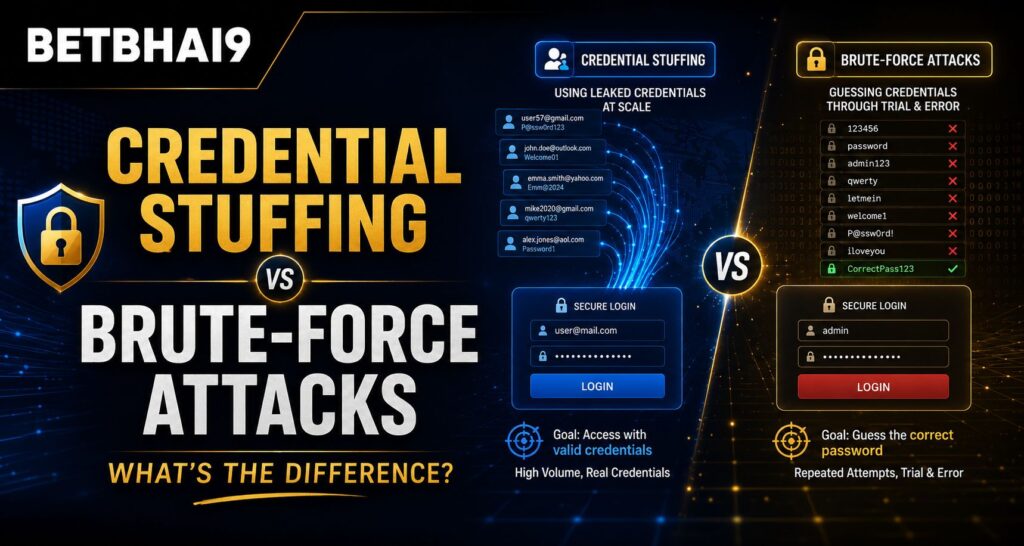
Online accounts face several password-related threats, but two terms are frequently confused: credential stuffing and brute-force attacks. For users accessing Betbhai9, understanding the difference can make safer login habits easier to follow. Both techniques attempt to gain unauthorised account access, but the way they operate is different. Brute force relies mainly on guessing passwords, while credential stuffing relies on username and password combinations that have already been exposed elsewhere.
What Is a Brute-Force Attack?
A brute-force attack attempts numerous password possibilities until one works.
OWASP describes traditional brute force as testing multiple passwords against a single account. The passwords might include common choices, predictable variations or other guesses.
Someone using Betbhai9 Login should understand that weak or predictable passwords make this type of attack easier.
Typical characteristics include:
- Many password guesses
- Repeated login failures
- Often targeting one account at a time
- Greater risk when passwords are short or common
- Reliance on automated login attempts
Modern websites can reduce this threat through login throttling, multi-factor authentication and controls that detect excessive failed attempts.
What Is Credential Stuffing?
Credential stuffing works differently.
Instead of guessing passwords from scratch, attackers use username and password combinations obtained from previous data breaches and test those credentials on other websites. The attack succeeds mainly because many people reuse the same password across multiple services.
For a Betbhai9 ID holder, this means even a strong password can become risky if the same credential is reused on another website that later suffers a breach.
The attack normally depends on:
- Previously exposed credentials
- Password reuse between websites
- Automated login attempts
- Large collections of username-password pairs
This is why security specialists strongly recommend unique passwords for different important accounts.
Credential Stuffing vs Brute Force at a Glance
The biggest difference is where the password attempts come from.
Brute force:
- Guesses potential passwords
- Often tests many passwords against one account
- Takes advantage of weak or predictable passwords
Credential stuffing:
- Uses credentials exposed elsewhere
- Tests known username-password combinations
- Takes advantage of password reuse
OWASP treats credential stuffing as part of the wider brute-force family, but distinguishes it because the attacker is working with credentials that may already be valid.
For Betbhai9 App users, the practical lesson is simple: both strong passwords and unique passwords matter.
Why Password Reuse Creates Extra Risk
Imagine that the same email address and password are used on five different websites.
If one of those services is compromised, the exposed credentials may later be tested against the other four. The attacker does not need to discover the password again.
This is the core problem behind credential stuffing.
Users accessing Betbhai9 Com should therefore avoid recycling passwords from social media, email accounts, shopping websites or other services.
A safer approach includes:
- Use a unique password for each important account
- Consider a trusted password manager
- Avoid minor variations of the same password
- Change reused credentials after a known breach
- Enable additional authentication when available
How Can Accounts Be Protected From Brute Force?
Websites should not rely on users alone to stop automated attacks.
OWASP recommends layered controls such as multi-factor authentication, weak-password checks and anti-brute-force mechanisms. Authentication systems should also detect or restrict excessive automated login attempts.
Betbhai9 Club users can improve their own account security by choosing passwords that are difficult to predict and avoiding sharing login credentials with anyone.
The Betbhai9 website currently states that its login process includes encrypted data systems and additional verification layers intended to help protect accounts from unauthorised access.
Why MFA Is Particularly Valuable
Multi-factor authentication adds another verification requirement beyond the password.
This means that obtaining or guessing a password may not automatically provide access. OWASP identifies MFA as one of the strongest defences against password-related attacks including brute force, credential stuffing and password spraying.
For Betbhai9 Login users, additional verification should therefore be completed whenever the legitimate platform requests it.
Never give verification codes to strangers claiming they need them to fix or verify an account.
Warning Signs Worth Taking Seriously
Users cannot always identify an attack directly, but certain account events deserve attention.
Watch for:
- Unexpected login alerts
- Password-reset messages you did not request
- Unfamiliar account sessions
- Repeated verification prompts
- Changes you did not make
Authentication failures and unusual bursts of login attempts are also important signals that service operators can monitor to detect potential account-takeover activity.
If a Betbhai9 App user suspects unauthorised access, changing the password to a unique one and reviewing available security controls is preferable to continuing with compromised credentials.
Conclusion
Credential stuffing and brute-force attacks both target login systems, but they use different approaches. Brute force mainly tries to guess a password, while credential stuffing takes credentials exposed elsewhere and tests whether they were reused.
For Betbhai9 Com users, the best defence begins with avoiding password reuse, choosing strong credentials and using extra verification when available.
Betbhai9 Club members should also treat unexpected recovery messages or login activity seriously. Security becomes considerably stronger when both the platform and the user follow layered authentication practices rather than depending on a password alone.
FAQs
What is the main difference between credential stuffing and brute force?
Brute force generally guesses many passwords, while credential stuffing uses username-password combinations previously exposed through another breach.
Why does credential stuffing work?
It works primarily because people often reuse the same credentials across multiple websites. A password exposed on one service may therefore unlock another account.
Can a strong password still be vulnerable to credential stuffing?
Yes. If the same strong password is reused elsewhere and becomes exposed, attackers may test it against other services.
Does multi-factor authentication help?
Yes. OWASP recommends MFA as one of the strongest protections against credential stuffing, brute-force attacks and other password-based threats.
What should I do if I reused a compromised password?
Replace it with a unique password on every account where it was reused, review account activity and enable additional authentication where available.