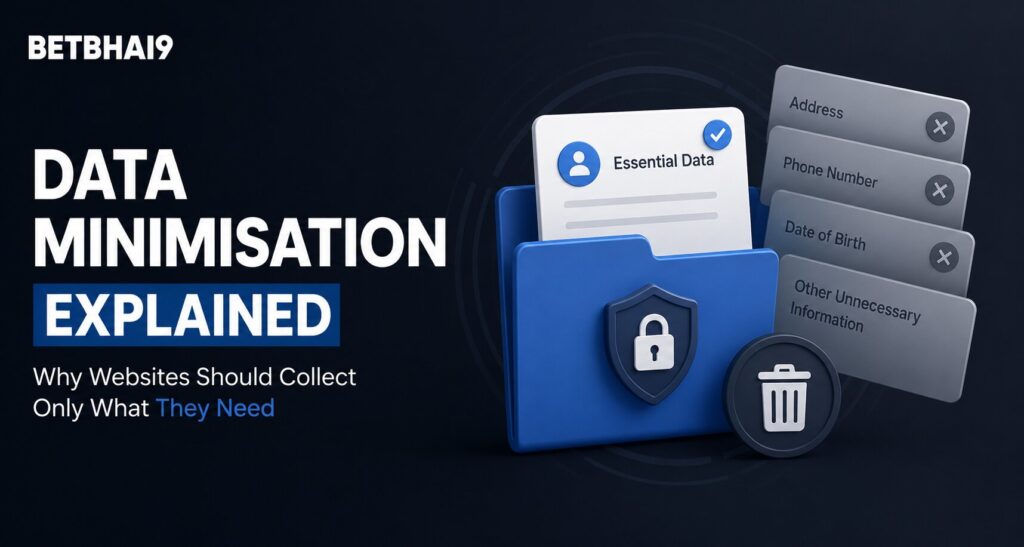
Websites often need some personal information to create accounts, verify users, provide services or process transactions. However, collecting more information than necessary can increase privacy and security risks without improving the user experience. For people accessing services such as Betbhai9, understanding data minimisation makes it easier to recognise why a website asks for particular details and when a request may deserve additional scrutiny. The principle is simple: collect information that serves a clear purpose and avoid collecting unrelated data “just in case.” The UK Information Commissioner’s Office defines data minimisation as using only personal information that is adequate, relevant and necessary for a specified purpose.
What Does Data Minimisation Mean?
Data minimisation is a privacy principle that limits personal-data collection to what an organisation genuinely requires.
Under Article 5 of the GDPR, personal information should be adequate and relevant while being limited to what is necessary for the purpose for which it is processed.
In simple terms, a website should ask:
- Why do we need this information?
- Is the information necessary for the service?
- Could the same purpose be achieved with less data?
- How long does the information need to be stored?
- Who actually needs access to it?
For someone using Betbhai9 Login, this principle means login information should serve account access and security purposes rather than automatically becoming a reason to collect unrelated personal details.
Why Collecting Less Data Can Improve Security
Every additional piece of stored personal information creates something else that must be protected.
If a database contains unnecessary information, a security incident could expose more data than would otherwise have been available. Collecting less therefore reduces the amount of information potentially affected by unauthorised access.
The ICO also advises organisations not to collect or retain personal information simply because it might become useful at some unknown point in the future.
For Betbhai9 App users, this is why permissions and account-information requests should ideally have an understandable connection with the feature being used.
Necessary Data Depends on the Service
Data minimisation does not mean websites should collect no personal information.
An online service may genuinely require information for:
- Account creation
- Age or identity verification
- Fraud prevention
- Payment processing
- Password recovery
- Customer support
- Legal or regulatory obligations
The current Betbhai9 website, for example, describes registration fields including a full name, email address, mobile number and date of birth, while stating that identity documents may be requested for KYC verification.
For a Betbhai9 ID holder, the useful privacy question is therefore not simply, “Is data being collected?” It is, “Is this data relevant to the stated purpose?”
Data Minimisation and Purpose Limitation Work Together
Collecting the minimum necessary data is only one part of responsible data handling.
Purpose limitation means organisations should be clear about why information is being collected and should not simply reuse it for unrelated purposes. The ICO explains that using personal information for a new purpose generally requires considering whether that new use is compatible with the original purpose.
For Betbhai9 Club users, this distinction can matter when personalised offers or account features are involved. Information needed to secure an account is not automatically the same information needed to personalise promotional content.
Clear separation between purposes makes privacy practices easier for users to understand.
Why Retention Periods Matter
A company might genuinely need information today without needing it forever.
Storage limitation complements data minimisation by requiring organisations to consider how long identifiable personal information should remain stored. The ICO states that organisations should not retain personal data longer than necessary for its purpose.
For Betbhai9 Com users, good privacy practice would therefore involve not only deciding what information is necessary but also considering when information should be deleted, anonymised or no longer actively retained.
What Should Users Check Before Sharing Information?
Users can apply a simple data-minimisation mindset themselves.
Before entering personal details, consider:
- Is this the recognised website or app?
- Why is this field required?
- Does the requested information make sense for the task?
- Is an optional field really necessary to complete?
- Does the privacy notice explain how information is used?
- Are sensitive documents being uploaded through an authorised process?
- Is someone requesting information through an unofficial chat?
For Betbhai9 Login users, passwords, OTPs and recovery codes should also be treated differently from ordinary profile information. Account-security secrets should never be shared merely because another person claims they need them.
App Permissions Are Another Form of Data Collection
Data minimisation also applies to smartphone permissions.
An application may request access to notifications, location, camera, microphone or files. The fact that Android or iOS allows an app to request a permission does not mean every app necessarily needs it.
A Betbhai9 App user should consider whether the requested access supports a feature they actually intend to use. If a permission appears unrelated, reviewing the purpose before allowing it is sensible.
Why Transparency Builds Trust
Minimal collection is most useful when it is combined with clear explanations.
Users should be able to understand what is collected, why it is needed and how long it may be retained. GDPR principles similarly connect data minimisation with transparency, purpose limitation and storage limitation.
For Betbhai9 ID and similar online accounts, clear explanations can reduce uncertainty during registration, verification and account recovery.
Conclusion
Data minimisation is based on a straightforward idea: websites should collect enough personal information to provide their service properly, but no more than is reasonably necessary.
For Betbhai9 users, that principle is relevant during registration, verification, mobile permissions and account support. Betbhai9 Com users can also protect their own privacy by questioning unexpected requests and providing sensitive information only through recognised processes.
Collecting less does not automatically make a service secure, but it reduces unnecessary exposure and makes responsible data management easier.
FAQs
What is data minimisation?
Data minimisation means collecting personal information that is adequate, relevant and limited to what is genuinely necessary for a defined purpose.
Does data minimisation mean websites cannot ask for identity details?
No. Identity information may be necessary for certain services, verification processes or legal obligations. The key question is whether each requested item has a legitimate and relevant purpose.
Why is unnecessary data collection risky?
More stored personal data means more information must be secured and potentially more information could be exposed if unauthorised access occurs.
Should websites keep personal data forever?
No. Privacy principles such as storage limitation require organisations to consider how long information is genuinely needed rather than retaining it indefinitely.
What should Betbhai9 Club users do if someone requests unusual personal information?
Verify the request through the recognised platform or authorised support channel before sharing anything. Avoid sending passwords, OTPs or sensitive documents through unexpected messages.