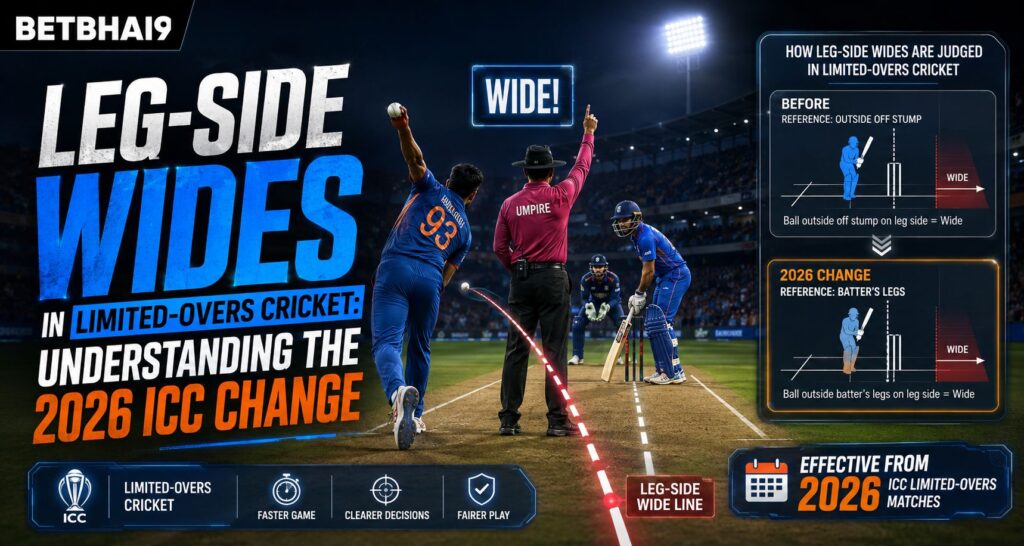
Limited-overs cricket has increasingly featured batters moving across the crease before the bowler releases the ball, creating difficult decisions over leg-side wides. For followers using Betbhai9, understanding the ICC’s revised approach helps explain why some deliveries that previously looked like automatic wides may be treated differently. Importantly, the change was announced by the ICC on June 27, 2025 and introduced as a six-month Full Member trial from October 2025, meaning the trial extended into early 2026 rather than originally being announced as a permanent 2026 law.
Why Did the ICC Trial a New Wide-Ball Interpretation?
Modern limited-overs batters frequently shuffle across their stumps, move outside off stump or change position before the ball arrives. That movement can make it difficult for bowlers to predict where they are allowed to deliver without being penalised.
The ICC said the trial was designed to give bowlers greater leniency when a batter moves before or during the delivery. Under the trial, the position of the batter’s legs at the point of delivery becomes an important reference when judging a leg-side wide.
For Betbhai9 Login readers, the change is mainly about balancing two competing skills: creative batter movement and a bowler’s ability to respond tactically.
How Did Leg-Side Wides Traditionally Work?
A wide is generally called when a delivery passes too far from the striker for them to hit it using a normal cricket stroke.
Current ICC tournament playing conditions state that umpires judge whether the ball passes wide of where the striker is standing and whether it would also have passed wide of a striker in a normal batting position. A batter’s own movement can also prevent a delivery from being judged wide in some circumstances.
The difficulty in limited-overs cricket arises when a batter moves dramatically after or around the moment of delivery.
For Betbhai9 App users following T20 cricket, those movements can make a legal-looking ball suddenly appear several inches down the leg side.
What Did the ICC Wide-Ball Trial Change?
The experimental interpretation introduced a clearer leg-side reference.
Under the trial:
- The position of the batter’s legs at the point of delivery is used as a reference.
- This remains relevant even if the batter subsequently moves toward the off side.
- The protected-area marker is extended toward the popping crease as an umpiring guide.
- A ball passing between leg stump and that marker may not automatically be called wide.
- A delivery passing behind the batter’s legs and outside the relevant line at the popping crease can still be called wide.
For a Betbhai9 ID holder, the key principle is that batter movement should not automatically create an extra-wide zone for the bowler to avoid.
A Simple Example of the New Interpretation
Imagine a right-handed batter begins in a normal position but then moves significantly toward the off side before attempting a scoop or leg-side shot.
The bowler reacts by delivering toward the area that was originally around the batter’s legs.
Under a very strict leg-stump interpretation, that delivery might look like a wide once the batter has moved away.
During the ICC trial, however, the umpire can use the batter’s leg position at delivery and the additional crease marking to judge whether the delivery remained inside the permitted area.
For Betbhai9 Club followers, this gives bowlers more tactical freedom against moving batters without allowing unrestricted negative bowling down the leg side.
Does Every Ball Outside Leg Stump Become Legal?
No. That is one of the biggest misunderstandings surrounding the change.
The ICC specifically stated that deliveries passing behind the batter’s legs and outside the designated line when they reach the popping crease may still be called wide.
The trial was therefore not designed to remove leg-side wides.
Its purpose was to provide a more consistent reference when batters move substantially across the crease.
A bowler repeatedly sending balls far down the leg side can still be penalised.
Why Could the Change Matter in T20 Cricket?
T20 batting increasingly involves unconventional movement. Batters use ramps, scoops, premeditated shuffles and different crease positions to disrupt bowling plans.
Giving bowlers a clearer reference could encourage them to respond more confidently when a batter moves.
For Betbhai9 Com readers, possible tactical effects include:
- More attempts at following moving batters
- Greater use of leg-stump yorkers
- Extra responsibility on batters to access unusual areas
- Fewer automatic wides created purely by large pre-delivery movement
- More attention on exactly when the batter changes position
The change therefore affects tactics as much as umpiring.
Was This a Permanent ICC Rule for 2026?
Not originally.
The ICC’s official announcement described it as a Full Member trial beginning in October 2025 for an initial six-month period.
That distinction is important for anyone following rules through the Betbhai9 App. Competition-specific playing conditions should always be checked because a trial rule is not automatically identical to a permanent universal law.
For example, the published ICC Men’s T20 World Cup 2026 playing conditions use the standard Clause 22 wording for judging wides rather than reproducing the trial language about the extended leg-side marker.
What Should Viewers Watch for?
When a close leg-side wide decision occurs, Betbhai9 Login followers should consider:
- Where the batter stood initially
- Whether the batter moved before delivery
- Where their legs were at the point of delivery
- The route of the ball past the popping crease
- Whether competition-specific trial conditions apply
Simply seeing the ball pass outside leg stump does not always explain the complete umpiring decision.
Conclusion
The ICC’s leg-side wide experiment was created to address one of modern limited-overs cricket’s growing tactical challenges: batters moving significantly before the delivery and effectively changing the bowler’s target.
For Betbhai9 users, the easiest way to understand the change is that the batter’s position at the point of delivery became a more important reference during the trial. It gave bowlers additional flexibility while retaining protections against genuinely wide leg-side bowling.
Betbhai9 Com readers should also remember that the measure began as a trial, so the exact playing conditions of the tournament being watched remain the final authority.
FAQs
When was the new leg-side wide rule introduced?
The ICC announced the trial on June 27, 2025, with Full Member trials scheduled to begin in October 2025 for an initial six months.
Does every ball outside leg stump now count as legal?
No. Deliveries passing behind the batter’s legs and outside the designated reference line may still be called wide.
Why did the ICC change the interpretation?
The trial was intended to give bowlers more flexibility when batters move significantly before or during delivery.
Does the batter’s movement affect a wide call?
Yes. Batter position and movement are relevant when umpires determine whether a delivery was reasonably within reach.
Was the change automatically permanent in 2026?
No. The specific leg-side provision was announced as an initial six-month trial. Tournament and competition playing conditions should therefore be checked for the applicable rule.